

Introduction: The Sourcing Problem Behind the Eco Trend Plant-based cat litter has become a regular line in pet supply ranges, driven by retailers responding to customers who want alternatives to mineral clay. For importers, wholesalers, distributors, and private-label brands, however, "plant-based" is only a positioning label — the commercial decision depends on absorption, clumping, dust, odor control, packaging, storage stability, and supply reliability.
The points where buyers most often get into trouble are consistent:
· Assuming every plant-based product performs alike, when tofu, cassava, millet and wood-based formulas have different absorption, clump strength and storage behavior.
· Publishing biodegradable, compostable or flushable claims without test evidence for the finished product.
· Comparing one bag weight instead of density, pallet configuration and full landed cost.
· Ordering a product whose moisture-sensitive packaging is not protected for long-distance shipping.
· Selecting a supplier on factory price alone, without checking batch consistency, QC documentation or export capability.
This guide explains the real benefits and limits of plant-based litter, what to compare against clay litter, and the documentation and checks buyers should request before a bulk order. To see the products PetsLoveWorld supplies, browse the Cat Litter category page; shortlist a substrate, then use the Contact Us page for samples and a wholesale or private-label quote.
1. What Plant-Based Cat Litter Actually Is
Plant-based cat litter is made primarily from plant or agricultural materials rather than mineral clay. Raw materials such as soy fiber, pea fiber, cassava starch, millet starch, corn, wheat, wood fiber or recycled paper are processed into sticks, pellets, granules or other absorbent forms. For wholesale buyers, the term is only a starting point: the actual material composition, binding agents and manufacturing process determine how the finished product performs.
Table 1. Common plant-based litter formats and what buyers should evaluate
|
Format |
Common characteristics |
What buyers should evaluate |
|
Tofu litter |
Stick or strip pellets from soy/pea fiber; often water-soluble |
Dissolution behavior, clumping, moisture resistance, packaging |
|
Cassava starch litter |
Rounded starch granules; firm clumps, low dust |
Absorption, clump strength, non-stick residue, dust level |
|
Millet starch litter |
Fine soft granules; gentle on paws |
Soft-stool wrapping, dust, fine-particle tracking, clumping |
|
Other plant formats |
Corn, wheat, wood pellets, recycled paper |
Absorption, pellet durability, dust, storage stability |
Ask the manufacturer for the full material declaration. A product described as plant-based may still contain processing agents, binders or small amounts of other ingredients, and that composition affects claims you can make on the bag.
2. The Seven Benefits That Matter for Wholesale Buyers
The advantages of plant-based litter are real, but each one depends on the raw material, formulation and production process. The extent of the benefit should be confirmed against samples and technical documents rather than assumed from the label.
2.1 Multiple plant-derived material options
Different materials support different product positioning: tofu and cassava suit eco and low-dust ranges, millet suits a soft-texture indoor niche, and wood or paper formats fill pellet-style demand. The purchasing question is not whether a product contains plant material, but where the material comes from, how consistent the composition is, and whether batch quality can be maintained.
2.2 Potential biodegradability
Some plant-based products can biodegrade under suitable conditions, which appeals to retailers and consumers prioritizing waste reduction. Plant-based does not automatically mean biodegradable or compostable: the rate and extent of decomposition depend on raw materials, processing, additives and the disposal environment. Before publishing terms such as "biodegradable," "compostable" or "eco-friendly," request the material composition, any relevant test report, the test method and conditions, information on additives, and disposal guidance supported by evidence.
2.3 Lighter product formats
Some plant-based litters are lighter than comparable clay litter, which can make individual bags easier to handle and influence pallet and warehouse planning. A lighter bag does not necessarily mean lower freight: costs depend on density, bag and carton dimensions, pallet configuration, container loading efficiency and actual versus volumetric weight. Compare products using consistent packaging and shipping assumptions — net weight per bag, bags per carton, cartons per pallet and total load per container.
2.4 Effective moisture absorption
Absorption is one of the most important performance factors. The relevant questions are how much liquid the product absorbs, how quickly, whether it saturates easily, whether it retains structure after absorbing moisture, and whether it leaves wet residue at the bottom of the box. Test samples with the same liquid volume, method and observation period; do not assume similar raw materials give similar absorption.
2.5 Fast and firm clumping
Clumping drives customer satisfaction and repeat purchase. Two factors matter: clumping speed — how quickly a removable clump forms after liquid contact — and clump strength — whether the clump holds together during scooping or breaks apart. A product that clumps fast but crumbles during cleaning does not deliver a satisfactory experience. Compare clumping time, clump integrity, residue and ease of scooping under identical test conditions. Any published clumping time or strength rating should be backed by product testing.
2.6 Low-dust formulations
Dust is a major buyer and consumer decision factor. Plant-based materials can be processed into different particle sizes, and some lines use a dedusting process to reduce loose particles. "Plant-based" and "low-dust" are not interchangeable: a plant-based product can still generate dust during production, transport, pouring or use. Ask about dust-control procedures, particle-size distribution, screening and sieving, dust test methods and results, and packaging protection in transit. Avoid the term "dust-free" unless performance substantiates it.
2.7 Odor control performance
Odor control works through moisture absorption, clumping, material characteristics and any added odor-control ingredients; the result depends on formulation. Evaluate odor control under normal use and after repeated liquid exposure, check whether fragrances or additives are included, and ask whether odor-control claims have supporting test results. For private-label brands, odor performance strongly influences reviews and repeat purchases, so evaluate it early.
3. Plant-Based Litter vs Traditional Clay Litter: What Buyers Compare
Neither category is automatically better in every situation. The right choice depends on target customer, performance, pricing, distribution requirements and brand positioning. Most retailers sell both to serve different preferences.
Material difference
Traditional clay litter is mineral-based, commonly bentonite; plant-based litter derives from plants and agricultural resources. This affects weight, texture, processing and disposal characteristics. Request material declarations and confirm whether the finished product contains additives or non-plant components.
Absorption and clumping
Both categories can be designed for absorption and clumping, but performance varies by product. A category-level comparison is not enough: test individual products for liquid absorption capacity, absorption speed, clumping time, clump strength, residue after scooping and performance after repeated use, using identical conditions across suppliers.
Dust and odor control
Dust and odor depend on formulation and manufacturing process, not category label. Some plant-based lines are developed with dust reduction as a key feature, and clay products also vary. Request test reports and compare actual samples, covering pouring dust, loose particles, odor performance and condition after moisture exposure.
Weight, freight and landed cost
Plant-based options may be lighter, but the lightest product is not necessarily the most economical to import. Consider net weight per retail bag, product density, bag and carton dimensions, pallet configuration, container loading capacity, freight cost per unit and damage risk in transit. A higher unit price can still be attractive if packaging and loading improve total landed cost; confirm with actual supplier quotations and freight estimates.
Environmental considerations
Plant-based sourcing and end-of-life options may offer advantages, but environmental performance depends on the whole product and its disposal pathway. Compare raw material sourcing, manufacturing process, packaging, transportation, disposal requirements and verified biodegradability or compostability claims. Do not describe every plant-based product as environmentally superior without supporting evidence.
4. Eco Claims: Biodegradable, Compostable and the Evidence Behind Them
Environmental claims appear on packaging, websites and listings, so the distinction between terms matters for importers.
· Biodegradable: a material can be broken down by microorganisms under suitable conditions; time and extent depend on material and environment.
· Compostable: a material breaks down under defined composting conditions and meets the relevant standard or certification.
A product may be biodegradable without being suitable for home or industrial composting. Before approving a claim, request documentation that identifies the exact product or material tested, the testing standard or method, the testing environment, test duration, results and limitations, and any applicable certification. Do not assume a product is compostable simply because it is made from corn, tofu, wood or another plant material.
Raw material sourcing also matters: ask where materials are sourced, whether they are agricultural by-products or purpose-grown crops, whether quality can be kept consistent, whether sourcing documents are available, and how the manufacturer manages raw material changes. For brands with sustainability commitments, documented sourcing is more useful than broad claims such as "100% natural."
Disposal instructions must follow the specific product and local waste rules. Used litter contains animal waste, which adds hygiene and public-health considerations. If a product has not been tested or approved for a disposal method, do not market it that way.
5. Limitations Buyers Must Plan For
Differences between raw materials
Corn, tofu, cassava, millet, wood and paper differ in structure, processing and performance. A pellet-style wood litter and a clumping tofu litter are not direct substitutes; evaluate each product individually rather than treating plant-based as one uniform category.
Moisture and storage requirements
Some plant-derived materials are moisture-sensitive in storage and transit. Excess humidity or water exposure can change texture, clumping behavior or product integrity. Confirm recommended temperature and humidity, whether moisture-resistant packaging is required, available shelf-life information, post-opening storage and any special requirements for long-distance shipping. Where shelf-life or stability claims are made, request supporting data.
Performance consistency
A product that performs well in one sample may not perform identically in every batch. Raw material variations, moisture content, particle size and manufacturing conditions all affect finished quality. Ask about incoming raw material inspection, process controls, particle-size management, moisture testing, finished-product inspection, batch identification and traceability, and procedures for nonconforming products. A written specification and agreed quality standards manage expectations on both sides.
Purchasing and transportation costs
Plant-based litter has different production, packaging and logistics costs from clay. The relevant figure is not factory price alone: include product price, retail packaging and cartons, custom printing or private-label costs, inland transport, export handling and documentation, ocean or air freight, insurance, duties and import charges, port and destination handling, warehousing and domestic distribution. Obtain current quotations rather than relying on category-level price comparisons.
6. Sourcing Checklist Before a Bulk Order
A competitive factory price should not be the only deciding factor. Evaluate performance, manufacturing quality, supply capacity, customization and shipping requirements.
Table 2. Specification points to request for a plant-based litter product
|
Specification |
Why it matters |
|
Raw material composition |
Confirms what the product is made from, including any additives |
|
Particle size and shape |
Influences texture, handling, dust and product consistency |
|
Moisture content |
Helps assess product condition and storage requirements |
|
Bulk density |
Supports packaging and shipping calculations |
|
Absorption capacity |
Indicates moisture-handling performance |
|
Clumping time and strength |
Evaluates cleaning convenience and clump integrity |
|
Dust level |
Supports dust-related product claims |
|
Odor-control features |
Clarifies how odor management is addressed |
|
Shelf-life information |
Helps with inventory planning |
Quality control and testing: request specification sheets, laboratory test reports, raw material documentation, inspection records, batch traceability and relevant certifications. Check that reports relate to the actual product being purchased — a general company certificate does not prove a specific formulation meets a performance claim. Agree acceptance criteria for important characteristics before production.
Manufacturing capacity: ask about production lines, monthly or annual capacity, current lead times, MOQ, raw material availability, peak-season planning and backup arrangements for supply interruptions. Confirm whether the factory can consistently allocate capacity to your orders and produce each requested formulation and format.
OEM and private label: customization may include formulation, granule size or shape, fragrance, bag size and net weight, packaging material, printed bag design, carton design and branding. Clarify which features are standard and which require development, the MOQ per packaging design or formulation, artwork requirements, sample approval process, lead time and ownership of custom artwork. For a new brand, starting with an existing formulation and customizing packaging usually reduces development complexity.
Packaging and shipping: discuss bag sizes, barrier properties, sealing method, inner and outer packaging, carton strength, pallet configuration, container loading plan, shipping marks and labeling, and export documentation. If the product is moisture-sensitive, agree protective packaging and storage arrangements; do not assume standard packaging is sufficient.
Product Examples: PetsLoveWorld Plant-Based Litter Range
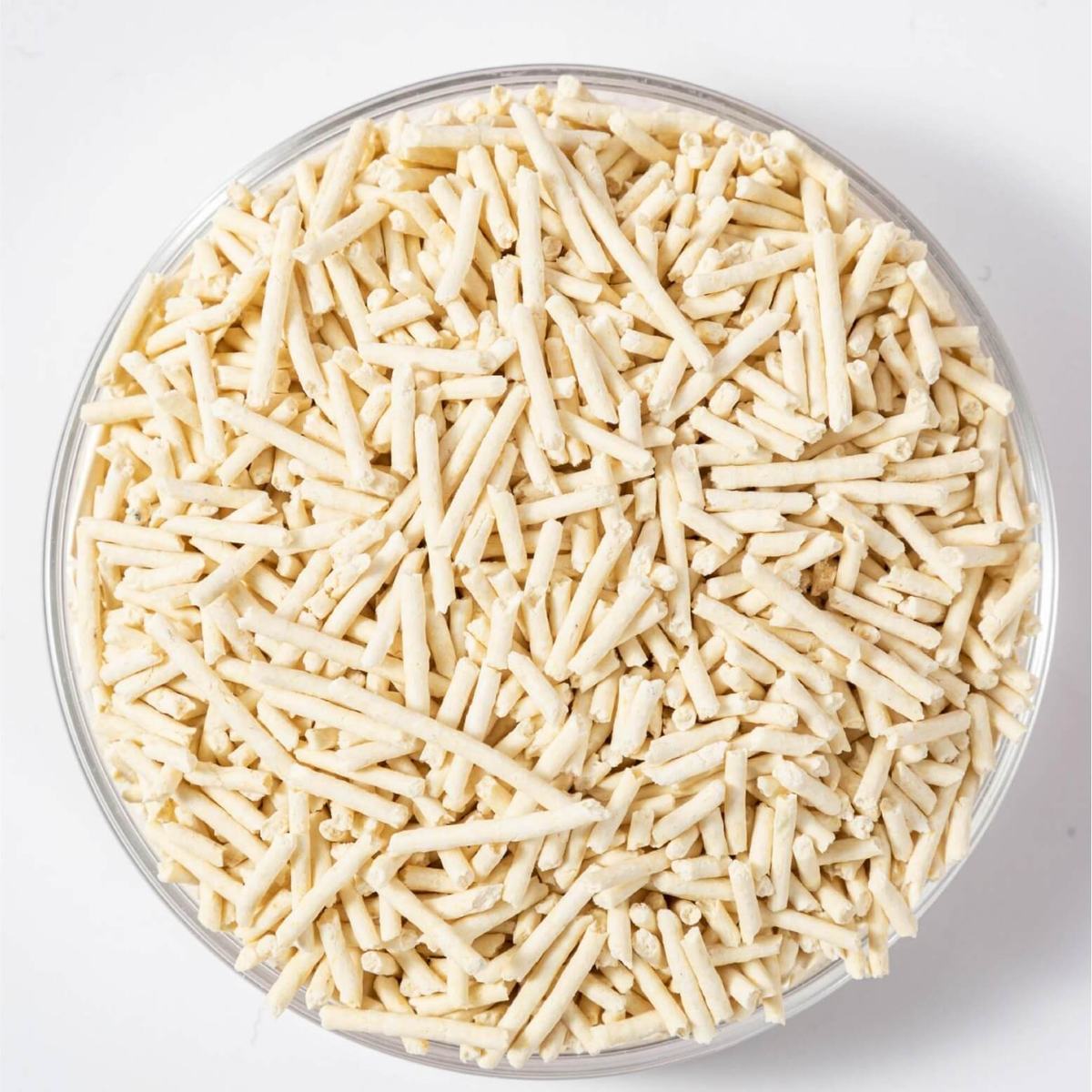
Example 1 — Natural Tofu Cat Litter
Product page: Natural Tofu Cat Litter
· Raw material: pea fiber and soybean residue; long-strip granules, 1.5mm or 2.0mm optional.
· Pack sizes: 2kg, 2.5kg, 6L or custom; moisture at or below 12%.
· Scents: Unscented, Milky and Green Tea; fast clumping, odor control, low dust and flushable small clumps.
· Documents: SGS and REACH available; MOQ negotiable for OEM private label; free samples for testing.
Next action: Request this SKU or a sample
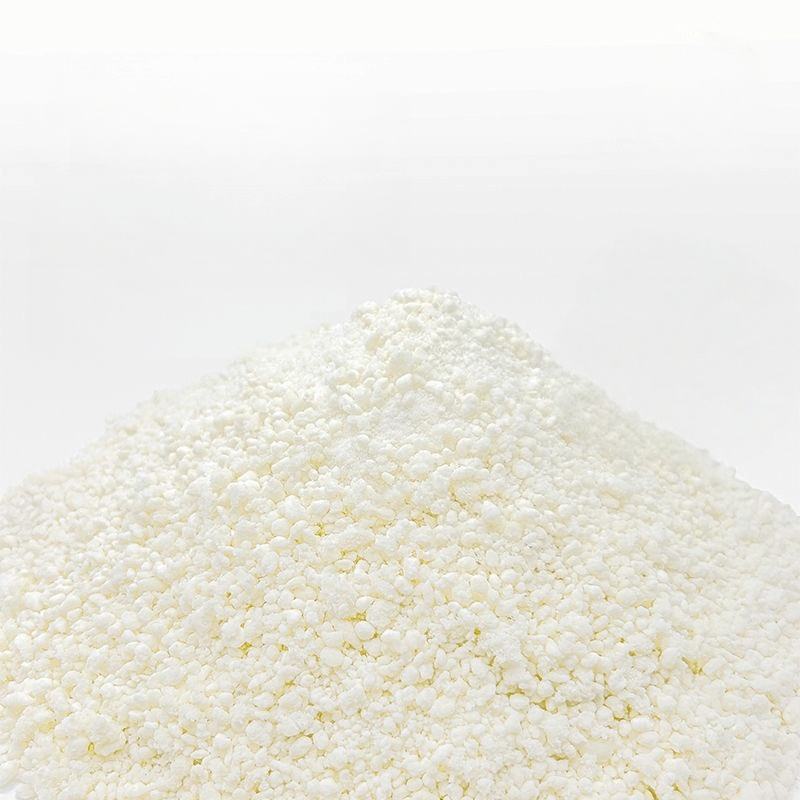
Example 2 — Natural Cassava Plant-Based Cat Litter
Product page: Natural Cassava Plant-Based Cat Litter
· Raw material: cassava (tapioca) starch, optional corn starch or baking soda; particle size 1.5–2.0mm, customizable.
· Packs: 1.25kg, 2.5kg, 6L or custom; moisture at or below 10%.
· Scent: unscented by default, milk flavor optional; negative-pressure dedusting for ultra low dust, firm non-stick clumps.
· Documents: SGS, REACH and BSCI available on request; MOQ negotiable for OEM; custom packaging and private labeling supported.
Next action: Request this SKU or a sample
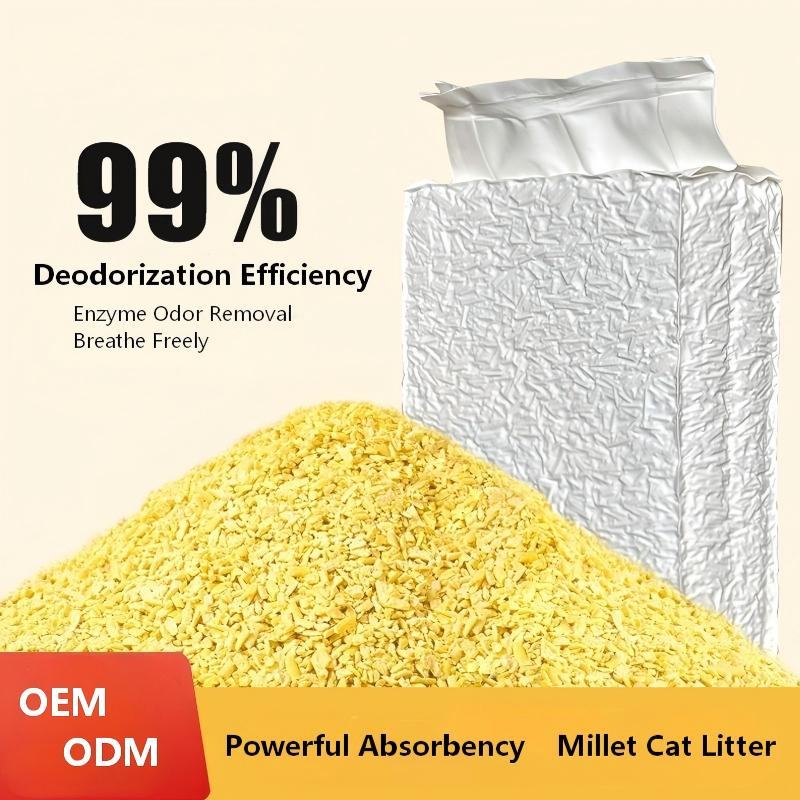
Example 3 — Natural Millet Cat Litter
Product page: Natural Millet Cat Litter
· Raw material: natural millet starch and plant fiber; fine millet-shaped soft granules.
· Scents: unscented or custom fragrance; low dust, fast clumping, odor lock, flushable and biodegradable.
· Suitable for kittens, adult cats and multi-cat families; MOQ negotiable for wholesale and private label.
Next action: Request this SKU or a sample
Table 3. Verified PetsLoveWorld specification overview for plant-based planning
|
Specification |
Natural Tofu |
Cassava |
Millet |
|
Material |
Pea fiber & soy residue |
Cassava starch |
Millet starch & plant fiber |
|
Particle size |
1.5mm / 2.0mm strips |
1.5–2.0mm, customizable |
Fine millet particles |
|
Moisture |
At or below 12% |
At or below 10% |
Confirm with PetsLoveWorld |
|
Scent |
Unscented, Milky, Green Tea |
Unscented, Milk |
Unscented, Custom |
|
Pack sizes |
2kg, 2.5kg, 6L, custom |
1.25kg, 2.5kg, 6L, custom |
Confirm with PetsLoveWorld |
|
Documents |
SGS, REACH |
SGS, REACH, BSCI |
Confirm with PetsLoveWorld |
|
MOQ |
Negotiable for OEM |
Negotiable for OEM |
Negotiable |
The range also includes the 70/30 tofu-bentonite mixed blend for buyers who want plant-based comfort with stronger clay clumping. Browse every option on the Cat Litter category page.
Buying Tips: Your Plant-Based Litter Procurement Checklist
1. Request the full material declaration, including any binders or additives, before positioning the product in your range.
2. Test samples under identical conditions — same liquid volume, observation period and scooping method — across every supplier.
3. Confirm moisture content and storage conditions, and check that the chosen bag has the moisture barrier the material needs.
4. Ask for bulk density and full loading data: bags per carton, cartons per pallet and load per container, not just per-bag weight.
5. Require test evidence for every dust, odor, clumping, biodegradable or compostable claim before it appears on packaging or listings.
6. Verify that certificates and reports belong to the specific formulation you are buying, not a general company document.
7. Confirm MOQ for both the product and any custom-printed film, plus deposit structure and production lead time.
8. Agree a written specification and reference sample before bulk production, with acceptance criteria for key parameters.
9. Model full landed cost — product, packaging, freight, duty, insurance and carry cost — before comparing retail margins.
10. Check export documentation capability and labeling requirements for your destination market before placing the order.
Frequently Asked Questions
Is plant-based cat litter safe for cats?
It can be formulated for cats, but safety depends on ingredients, processing, dust characteristics and intended use. Request the full material composition and relevant safety documentation; do not assume a product is safe simply because it is plant-derived. Manufacturers should support specific safety claims with evidence.
Is plant-based litter better than clay litter?
It depends on what you value. Plant-based options may offer plant-derived materials, lighter formats and potential biodegradability; clay may offer different absorption, clumping and pricing. Neither category is automatically superior. Compare actual products under consistent tests and calculate total landed cost before deciding.
Can plant-based litter be flushed?
Do not assume it is flushable. Biodegradable material does not mean plumbing-, wastewater- or regulation-safe, and used litter contains animal waste. Only make a flushability claim with product-specific evidence and consistent with local guidance; otherwise follow the verified disposal instructions.
Does plant-based litter control odor?
Many products manage odor through absorption, clumping or added formula features, but performance varies. Request test information where available and evaluate samples under consistent conditions; long-lasting odor claims need evidence relevant to the finished product.
Is plant-based litter suitable for wholesale?
Yes. It can be sold through wholesale, distribution, retail and private-label channels. Before bulk purchase, confirm specifications, sample performance, MOQ, factory capacity, QC procedures, packaging options, export experience and total landed cost.
What documents should I request before a bulk order?
Start with the specification sheet, COA, MSDS or safety data sheet, and any third-party reports such as SGS or REACH; add batch traceability, raw material documentation and relevant certifications. Confirm the reports match the actual formulation, and agree acceptance criteria before production.
Next Step: Browse the Range and Request Your Samples and Quote
You do not need a finished brand brief to start. Recommended path on PetsLoveWorld: browse the category, shortlist one or two substrates against the specification tables above, request samples to test absorption, clumping, dust and odor, then send a quote request with the details below.
· Substrate and SKU(s) you are interested in
· Target pack sizes, granule size and scents
· Label languages, destination market and compliance requirements
· Planned first-order quantity, and whether you need OEM packaging or a custom ODM formula
PetsLoveWorld replies with confirmed specifications, MOQ, lead times and FOB/CIF/DDP pricing; samples can be arranged before you commit.
Browse the full Cat Litter range, then submit your quote request on the Contact Us page. If you've already decided on a substrate, start with a pre-filled inquiry, such as the Natural Tofu sample request.