

Tofu cat litter and bentonite cat litter dominate the global cat litter market, and almost all wholesalers ultimately face the same question: Which type of cat litter should I stock, and how should I mix them? On the surface, this decision seems simple, but in reality, it affects every aspect of the product's profit and loss statement. Bentonite is a heavy mineral product with a low ex-factory price but high transportation costs; tofu cat litter is a lighter, plant-based granule, offering advantages such as environmental friendliness and flushability, but requiring higher quality standards.
For buyers new to this category, the following issues are common:
- Conflicting consumer trend signals—plant-based cat litter is growing rapidly, while bentonite still dominates sales in most markets.
- Unverified claims such as "low dust" and "quick clumping" appear generic on supplier lists.
- Drastically different container economics: clay cat litter reaches weight limits before the container is full, while tofu granules can fill the container first.
- Uncertainty about whether to launch a flagship product, stock both types, or offer a mix.
- Complex private label operations, with minimum order quantities and lead times for granule quality and custom packaging.
This guide compares tofu and bentonite using actual PetsLoveWorld specifications, considering performance, cost, shipping, market positioning, and OEM quality. You can browse all products at any time on the cat litter category page.
1. What are Tofu Cat Litter and Bentonite Cat Litter?
Bentonite Cat Litter
Bentonite cat litter is a mineral product, typically made by drying, crushing, and grading sodium-based bentonite into granules. When it comes into contact with water, the bentonite swells and forms hard clumps, making it easy to clean, while the surrounding litter remains dry. Bentonite is a non-flushing, non-biodegradable mineral product; its quality depends primarily on its dust-removing effect, granule size, clump strength, and odor control.
Tofu Cat Litter
Tofu cat litter does not contain bentonite. It is made by extruding food-grade plant fibers (usually pea fiber and soybean residue) into strips or granules and then drying them. Its porous plant structure quickly absorbs liquids, forming strong, water-soluble clumps that are small enough to be flushed down the toilet. Tofu cat litter is biodegradable, naturally low in dust, and non-toxic even if kittens chew on the granules. Its quality is determined by granule hardness, moisture content, dust-removing effect, and how easily it crumbles in the packaging.
2. Direct Performance Comparison
Table 1 compares the two technologies in terms of factors influencing end-consumer complaints and repurchase rates. It's important to note that neither technology is superior in every aspect—the appropriate choice depends on the customer profile, not on a single "better" product.
Table 1. Tofu vs bentonite performance at a glance
| Factor | Tofu cat litter | Bentonite cat litter |
| Core material | Pea fiber & soybean residue (plant) | Sodium bentonite clay (mineral) |
| Clumping | Fast, firm water-soluble clumps | Fast, very hard swelling clumps |
| Dust | Naturally low; depends on pellet hardness | Low-dust grades require multi-stage dedusting |
| Odor control | Plant fibers lock ammonia; scented options | Strong encapsulation; large granules wrap waste |
| Flushable | Small clumps flushable | Not flushable |
| Tracking | Fine pellets, low tracking grades available | Granules can be carried out of the tray |
| Kitten safety | Non-toxic, food-grade; unscented recommended | Clay dust is the main concern for sensitive cats |
| Eco profile | Biodegradable, plant-based | Mined mineral, not biodegradable |
| Disposal | Toilet or trash | Trash only |
In terms of practicality, bentonite cat litter continues to lead in terms of clumping hardness, stability, and litter texture, which is crucial for ordinary households and multi-cat households. Tofu cat litter, on the other hand, excels in dust control, flushability, environmental friendliness, and kitten safety, driving its growth in the urban and apartment markets.
3. Costs, Freight, and Container Economics
Wholesale decisions cannot be made solely based on factory prices, as the two products perform very differently in transportation and on the shelf.
Unit Price and CIF Cost
Bentonite typically has a lower ex-factory price, but it is denser and heavier. Containers are often not fully loaded before reaching their maximum load capacity, resulting in higher freight costs per kilogram and more labor-intensive warehousing and handling. Tofu granules are lighter, so shipments often reach their maximum volume first; their ex-factory price is usually higher, but unit freight and handling costs may be lower. Always compare CIF quotes that include the product, packaging bags, pallets, freight, insurance, and customs duties, not just the prices of the two bags.
Packaging Size and Fill Standards
Bentonite is usually sold by the kilogram or liter in large bags, while tofu is sold by both the kilogram and liter (e.g., 2 kg, 2.5 kg, and 6 liter packages). Since "liter" indicates volume, two bags of the same size may contain different weights. Please check the specifications for net weight, volume, and tolerances, and compare the profit margin per kilogram.
Storage and Humidity
Both tofu granules and tofu are sensitive to humidity, but tofu granules are hygroscopic and easily soften or swell in humid warehouses. Moisture-proof bags, proper pallet stacking, and dry storage methods can protect the product's quality from arrival to sale; please check the moisture content in the specifications—stable tofu granules typically have a moisture content below 11-12%.
4. Market Positioning: What Kind of Cat Litter Do Your Customers Want?
The key to success in business isn't which product is technologically superior, but rather which consumer groups exist in your market.
- Bentonite cat litter is suitable for mainstream, price-sensitive mass-market channels: supermarkets, large retailers, and traditional pet stores, as well as multi-cat households and consumers who prioritize clumping control and value for money.
- Tofu cat litter is suitable for urban apartment dwellers, environmentally conscious young consumers, high-end pet stores, and e-commerce platforms. Its easy-to-wash, low-dust, and biodegradable properties justify its higher price.
- Consumers in different regions have different scent preferences: unscented cat litter is the safest choice for sensitive cats, while scented cat litters such as green tea, milk, peach, and activated charcoal perform differently in different markets.
A low-risk SKU strategy involves stocking two products at different price points simultaneously, rather than choosing only one and adding a blend as a transitional offering. A 70% tofu/30% bentonite blend retains the plant-based, flushable properties while offering clay-like clumping strength, allowing retailers to test market demand without heavily relying on a single technology.
See the real Mixed Cat Litter product page for the 70/30 formula.
5. OEM, Private Label, and Quality Control
- Tofu: Particle hardness (55°is the premium standard), moisture content (maximum 11-12%), particle size (1.5mm, 1.8mm, or 2.0mm), strip shape, dust removal process, and aroma.
- Bentonite: Particle size, dust content and dust removal stage, clumping speed and strength, non-stick properties, and aroma.
- Packaging: Film type and moisture protection, bag size, graphic design, and label language. Custom-printed bags have their own minimum order quantity and lead time, separate from padding production.
- Documentation: Batch COA, MSDS, and third-party reports such as SGS and REACH (if required by the target market).
PetsLoveWorld supports OEM and ODM, private label, custom packaging and sample orders, with negotiable MOQ for OEM private-label business.
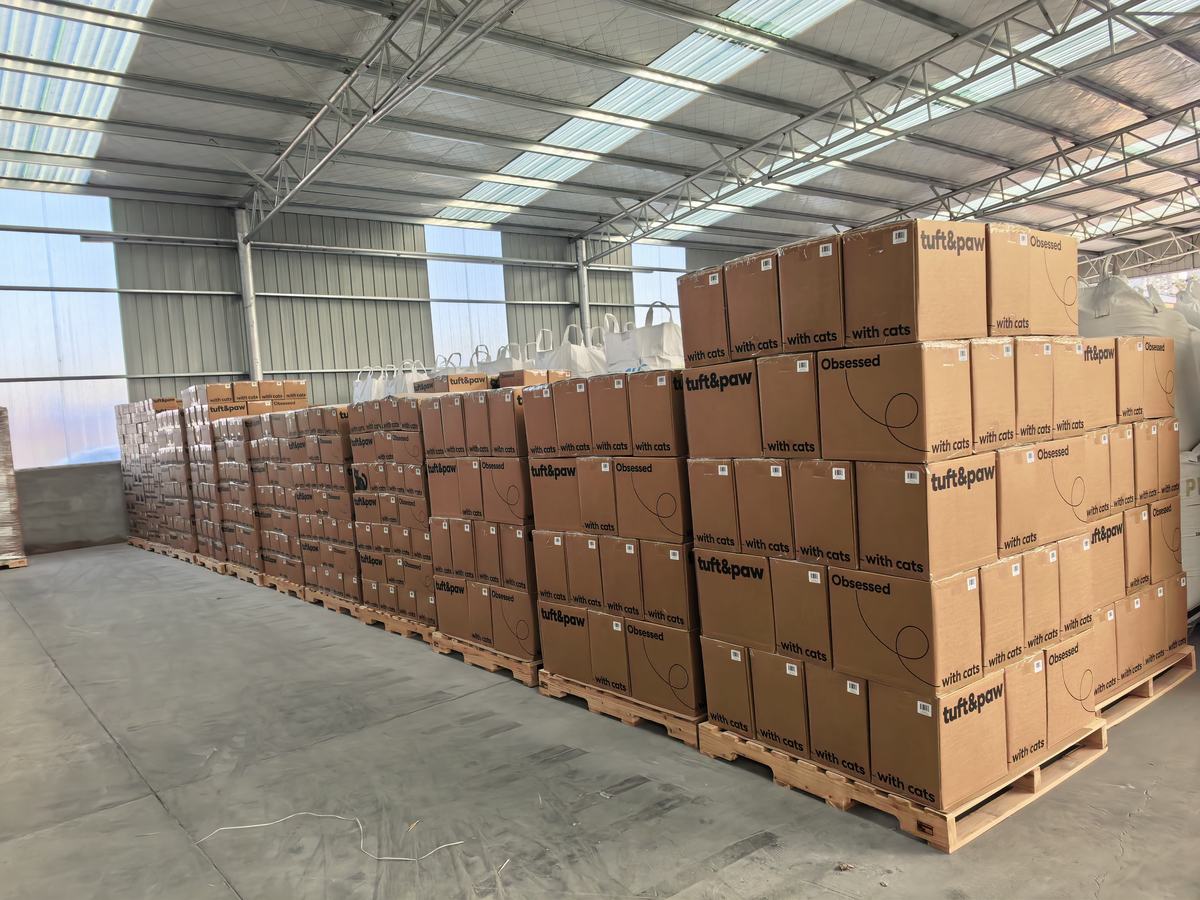
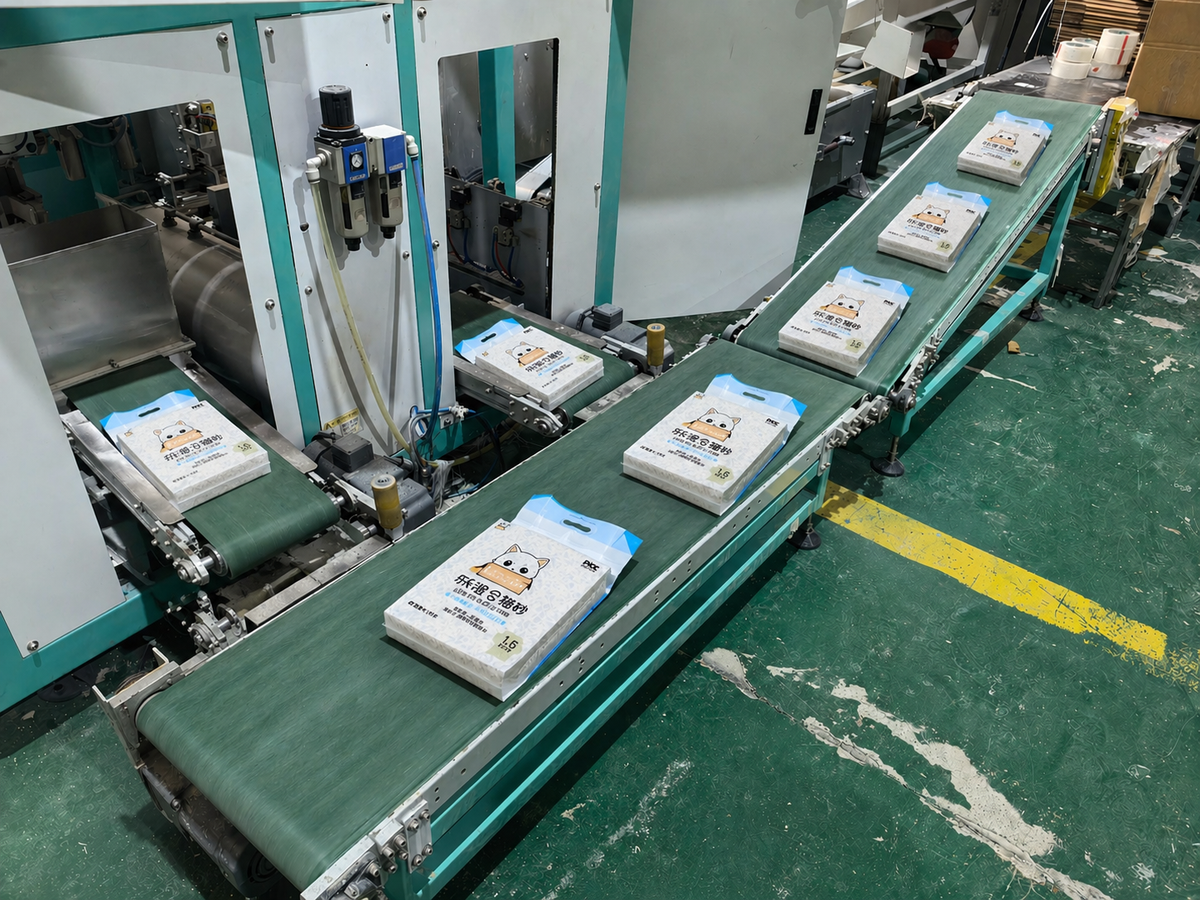
Product Examples: PetsLoveWorld Tofu and Bentonite with Real Specifications
Example 1 — Bentonite Cat Litter, Low Dust, Quick Clumping
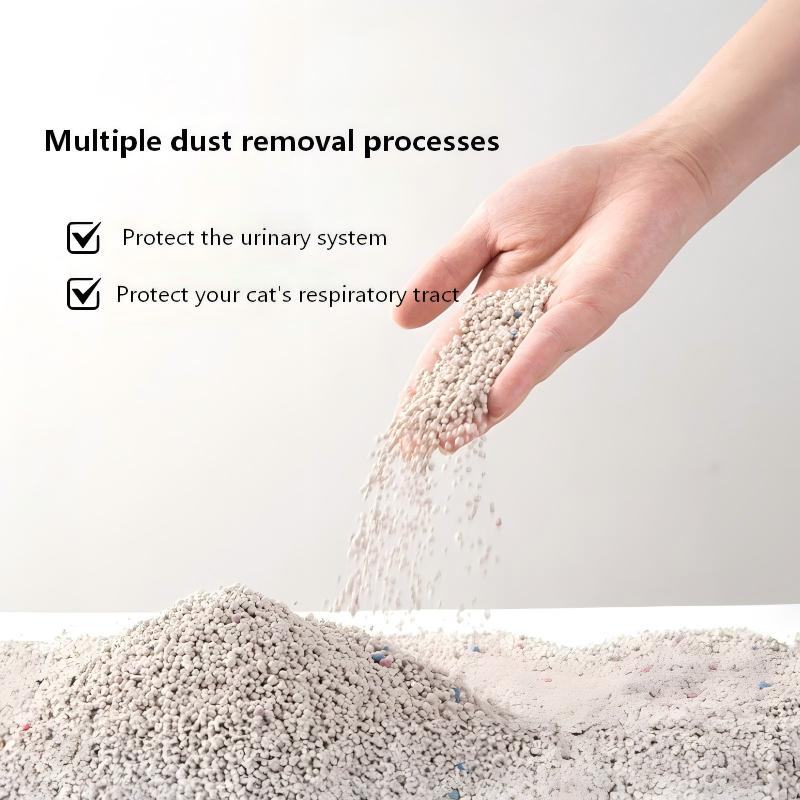
Product Page: Bentonite Cat Litter, Low Dust, Quick Clumping
● Type: Clumping Mineral Cat Litter; Main Ingredient: Bentonite.
● Features: Upgraded deodorizing formula, multi-stage low dust treatment, instant absorption, strong clumps, large granules, non-sticky, easy to scoop; suitable for single and multiple cats.
● Services: OEM, private label manufacturing and wholesale; customized packaging, fragrance and formula available.
Example 2 — Hard Tofu Cat Litter
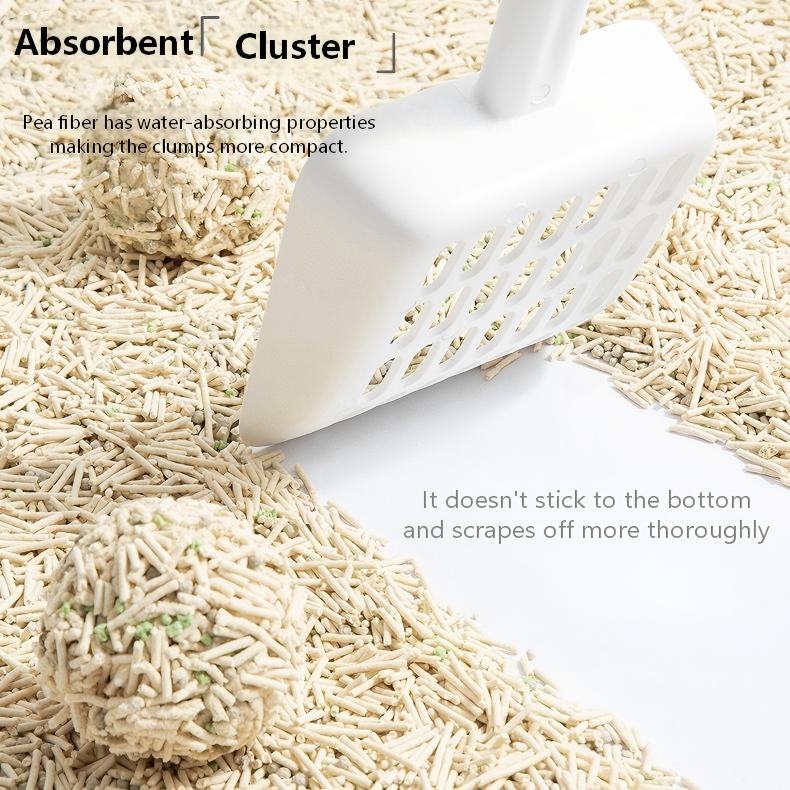
Product Page: Hard Tofu Cat Litter
● Type: Plant-based clumping cat litter made from pea fiber and soybean residue; hardness 55°, moisture content less than 11%.
● Pellet Size: 1.8 mm fine, uniform granules; low dust, low carryover, quick and stable clumping, small clumps can be flushed down the toilet.
● Scents: Original, Green Tea, Peach, and Activated Charcoal; OEM production and samples available.
Example 3 — Natural Tofu Cat Litter
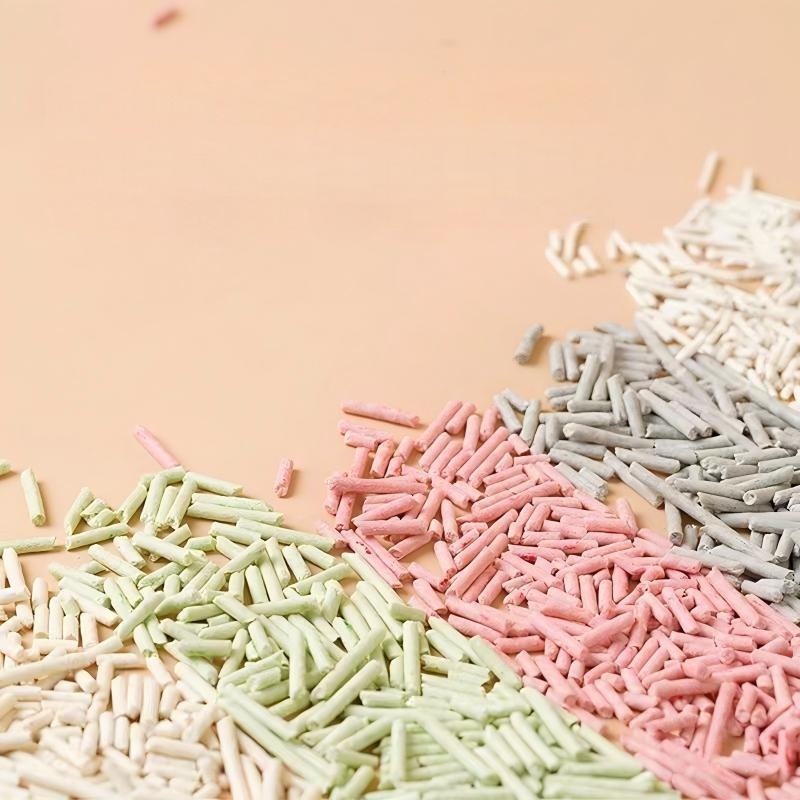
Product Page: Natural Tofu Cat Litter
● Ingredients: Pea fiber and soybean pulp; long granules, 1.5 mm or 2.0 mm available.
● Packaging: 2 kg, 2.5 kg, 6 liters or custom sizes; moisture content less than 12%; quick-clumping, low dust, small clumps, flushable.
● Fragrances: Unscented, milky, and green tea; SGS and REACH reports available; minimum order quantity negotiable for OEM production.
Example 4 — Low-Dust Tofu Scented Cat Litter
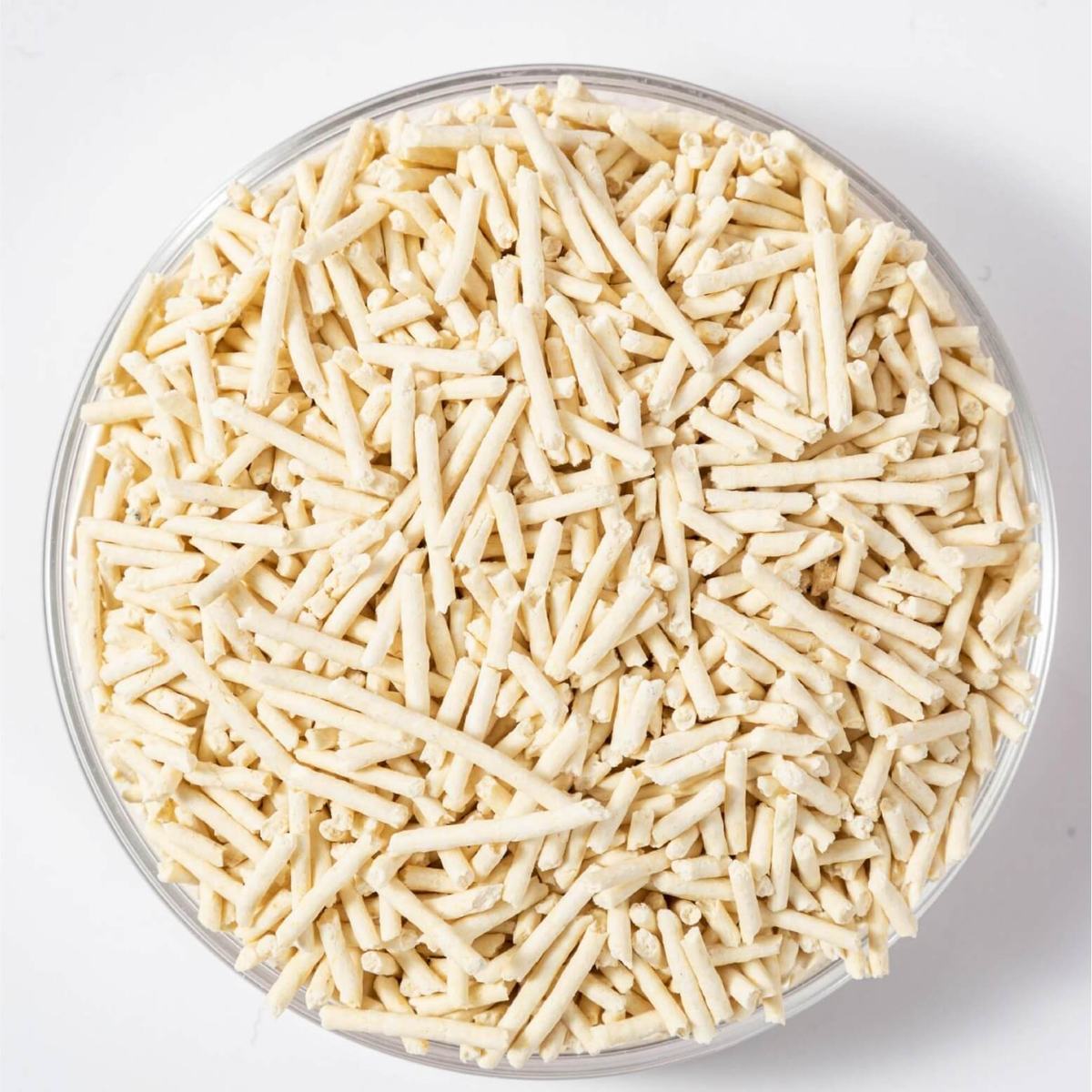
● Material: Natural plant fiber; granule diameter approximately 2 mm, with a light milky scent.
● Features: Water-soluble, flushable, clumps quickly, non-sticky at the bottom, low dust, locks in odors, and is not easily carried away.
● Services: OEM customization available; scent and packaging can be customized.
Pre-filled inquiry: Inquire about Scented Tofu Cat Litter
Table 2. Verified PetsLoveWorld specification overview (four featured SKUs)
| Specification | Bentonite | Hard Strength Tofu | Natural Tofu | Scented Tofu |
| Type | Clumping mineral | Plant-based clumping | Plant-based clumping | Plant-based clumping |
| Material | Bentonite | Pea fiber & soy residue | Pea fiber & soy residue | Natural plant fiber |
| Particle size | Large granules | 1.8mm pellets | 1.5mm / 2.0mm strips | Approx. 2mm pellets |
| Moisture | Confirm with PetsLoveWorld | Below 11% | At or below 12% | Confirm with PetsLoveWorld |
| Key specs | Low dust, hard clumps, non-stick | 55° hardness, low tracking | Flushable, fast clumping | Milky scent, flushable, low dust |
| Scents | Confirm with PetsLoveWorld | Original, Green Tea, Peach, Carbon | Unscented, Milky, Green Tea | Mild milky |
| Pack sizes | Confirm with PetsLoveWorld | Confirm with PetsLoveWorld | 2kg, 2.5kg, 6L, custom | Custom available |
| Certificates | COA, MSDS | COA, MSDS | SGS, REACH | COA, MSDS |
These four SKUs sit within a wider eight-product range that also includes cassava, millet and the 70/30 mixed blend. Browse the full selection on the Cat Litter category page.
Purchasing Tips: Wholesale List
1. Order samples of both types of tofu and conduct the same comparative tests: pour test for dust content, add water to test water absorption, press test for clumping strength, and check if it adheres to the bottom of the pallet.
2. Compare the final landed cost per kilogram—including ex-works price, packaging bags, pallets, freight, insurance, and customs duties
3. Request a written container loading plan from the supplier for each product, including the number of packaging bags per pallet, the number of pallets per container, and the gross weight within your shipping route's limits.
4. Identify measurable specifications on the approved list: tofu firmness and moisture content (baseline values are 55° and 11-12%, respectively), particle size, bentonite dust content and dust removal stage, and net weight tolerance.
5. Request the supplier to provide a Certificate of Analysis (COA), Material Safety Data Sheet (MSDS), and third-party reports (such as SGS or REACH reports), and schedule pre-shipment inspections for first-time orders with new suppliers.
6. Verify the term "fluffable" according to local wastewater treatment and packaging regulations, and be careful with the wording—limit it to small amounts of clumping, never mention large amounts of clumping.
7. Confirm two minimum order quantities separately: cat litter production and custom-printed packaging bags, each with its own lead time.
8. Plan the product line according to distribution channels: bentonite cat litter for the mass market and multi-cat households, tofu cat litter for the high-end urban market and e-commerce channels. Additionally, a 70/30 blend formula can be chosen if a transitional product is needed.
9. Understand consumer scent preferences based on your own market data; kittens and sensitive cats should use unscented cat litter by default.
10. Before paying a deposit, be sure to confirm the storage guidelines and the claims/replacement policy for moisture damage or non-conforming batches in writing.
Frequently Asked Questions
Q: Which is cheaper to wholesale, tofu or bentonite?
Bentonite typically has a lower ex-factory price, but it's heavier, resulting in higher transportation and handling costs. Tofu has a higher unit price, but its weight is lighter per shipment. The correct comparison is to calculate the CIF price at the destination, not the ex-factory price.
Bentonite forms the hardest and most common clumps through expanded clay. High-quality tofu granules with high hardness and low moisture content also form strong, stable clumps that are difficult to remove and are water-soluble and flushable.
Q: Can tofu cat litter really be flushed down the toilet?
Small tofu clumps are designed to dissolve and can be flushed down the toilet, but local wastewater regulations and pipe capacity must be followed. Large tofu clumps should absolutely not be flushed down the toilet; bentonite should never be flushed down the toilet under any circumstances.
Q: Which cat litter produces less dust?
Tofu naturally produces less dust, especially hard-grained tofu that has been thoroughly dusted. Bentonite requires multiple dust removal processes to achieve a low-dust rating; therefore, always inquire about specific dust specifications rather than simply accepting the "low-dust" label.
Q: Which is better for kittens and multi-cat households?
Tofu is non-toxic and food-grade, making it safer for kittens; unscented is best. For multi-cat households, bentonite remains popular due to its firm clumps and strong odor-sealing ability, while high-quality tofu and 70/30 blended tofu also perform well.
Q: Can I pack both products in one container?
Yes. Suppliers typically allow multiple SKUs (including tofu and bentonite) mixed in one container, while custom-printed bags have separate minimum order quantities and lead times. Please confirm the allowed SKU quantities and pallet packaging methods in writing.
Q: Should I stock both, or only one?
Stocking both tofu and bentonite at different price points covers both the mass and high-end markets and is the default choice for most retailers due to lower risk. If container or shelf space is limited, a 70/30 mixed pack can be used as a single transitional SKU.
Ready to compare tofu and bentonite for your next order?
Please send an inquiry specifying your required cat litter type, granule size and scent, packaging requirements, quantity, and port of destination. PetsLoveWorld will reply with confirmed specifications, minimum order quantity, delivery time, and FOB/CIF/DDP price, and can arrange samples before you make any bulk order commitments.
Request a Quote on the PetsLoveWorld Contact Us page , or browse the full Cat Litter category first. If you already know the product, use a pre-filled inquiry such as the Hard Strength Tofu inquiry form.